
Southern West Virginia’s popular tourism destination recently marked 25 years.
The idea that “if you build it, they will come” is seen every year on the Hatfield-McCoy Trails. Plans for the trails as an economic development project began in the early 1990s, driven by the desire to promote tourism in southern West Virginia. Surveys of community leaders were conducted by the newly formed Hatfield-McCoy Recreation Development Coalition and the U.S. Army Corps of Engineers, along with feasibility and economic impact studies.
Then, in 1996, the Hatfield-McCoy Regional Recreation Authority was established by the West Virginia Legislature to oversee the continual development of the Hatfield-McCoy Trails project. While the initial plan included seven counties, it was later revised to include two more. In 2018, five more counties were added, and by the time the trails opened in October 2000, there were more than 300 miles of trails.
The trails, while widely used by ATV, UTV and dirt-bike riders, are also accessible to hikers, mountain bikers and horseback riders. Visitors often prefer “destination riding”— staying on the trails multiple days and exploring different areas each day.
The trails are operated through a public-private partnership between landowners and the Hatfield-McCoy Regional Recreation Authority, which is governed by a multicounty board.
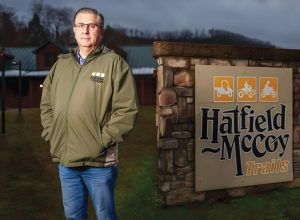 For most of the trails’ history, they were overseen by Jeff Lusk, who served as executive director for over 20 years. Lusk had been an economic developer in Virginia when he was pulled in to work on the trails project, making him a part of it from the beginning.
Now that Lusk has retired, John Fekete, who served as deputy executive director for those 20 years, is stepping into the role. So far, the transition has been smooth, thanks not only to well-established practices but also to the hard work and dedication of the 70 staff members who maintain the trails across mountainous terrain, which can be challenging.
Additionally, Fekete said, Lusk is just a phone call away whenever his experience is needed.
“Jeff has been a huge part of getting us where we are now,” Fekete said. “I had the pleasure of working with him for 20 years as deputy executive director. He will be missed.”
The Hatfield-McCoy Trails project adds millions of dollars annually to West Virginia’s economy. It draws  thousands of visitors each year, which means nonlocal spending at local businesses. This spending, along with annual expenditures to maintain and operate the trails, stimulates the local economy — and, by extension, the state of West Virginia. Most out-of-state visitors travel between five and eight hours to their destination on the trails and, once there, typically stay three to four days. Their stays typically include lodging, dining out, gas and other expenditures that help the local economy.
An economic and fiscal impact study conducted in 2021 by the Center for Business and Economic Research at Marshall University concluded that roughly $7.4 million in annual spending by the Hatfield-McCoy Trails generated an additional $7.3 million in economic activity within the state, which combined for a total operational impact of $14.7 million. Nonlocal visitors to the trails were estimated to generate an additional $53 million in economic activity, bringing the total economic impact close to $70 million.
 A survey conducted that same year indicated that over 60% of out-of-state respondents reported spending roughly $535 more per visit than visitors from within the state.
When Fekete took over, he wrote a 10-year strategic plan and presented it to the board. The plan was approved and soon set into motion.
His strategy focuses on encouraging longer visitor stays through expanded trail connectivity and attracting investors to develop lodges, resorts, cabins and other services that allow municipalities to benefit from increased tourism — a vision aimed at ensuring the trail system continues to drive opportunity for years to come.
Amy Deal is a freelance writer living in Barboursville, West Virginia.