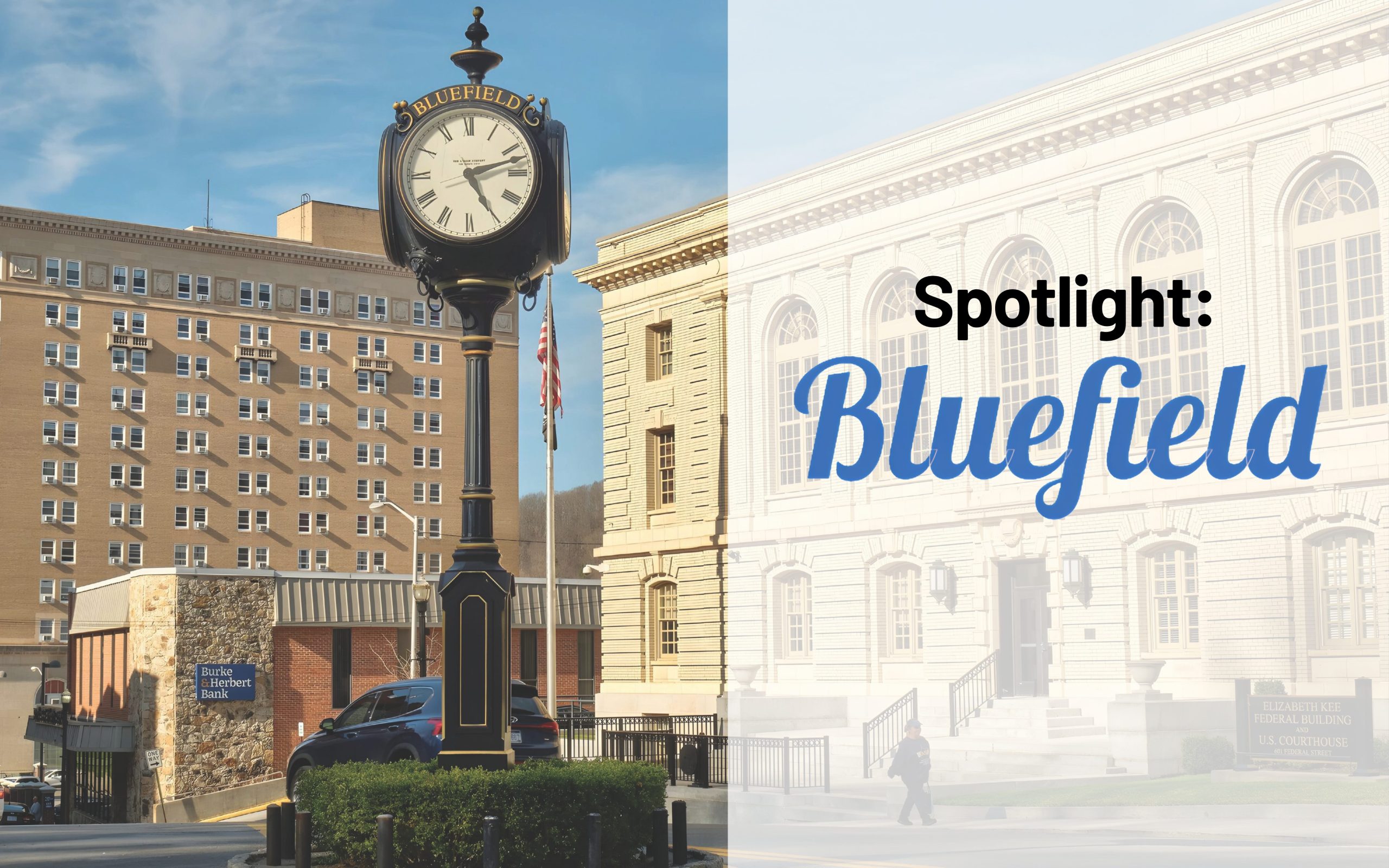
While many places complain about 90-degree weather, Bluefield turns it into a community celebration — complete with free lemonade. At approximately 2,611 feet above sea level, Bluefield enjoys cooler summer temperatures than other nearby communities. In 1939, the Bluefield Chamber of Commerce came up with the idea of giving away free lemonade to celebrate the days when the city’s temperature hit 90 degrees. But locals and visitors had to wait nearly two years, until 1941, for the city’s temperature to climb high enough for the first celebration.
From 1960 through 1982, Bluefield hit 90 degrees only once, making lemonade days rare. But the city celebrated 18 lemonade days during the summer of 2007, the most ever. The lemonade giveaway has cemented Bluefield’s reputation as “Nature’s Air-Conditioned City,” a nickname the community proudly embraces.
Coal and the Norfolk & Western Railroad gave birth to Bluefield. The history of Bluefield began in the 18th century, when the Davidson and Bailey families settled in a rugged and remote part of what is now southern West Virginia. Other families joined them, and they built a small village with a mill, a church, a one-room schoolhouse and a fort for defending the settlement against attacks by the Shawnee tribe, which had a village on the banks of the Bluestone River.
Beneath the land of the Davidsons and Baileys lay the largest and richest deposit of bituminous coal in the world. The first seam was discovered in nearby Pocahontas, Virginia, in the backyard of Jordan Nelson. The coal seam had been mentioned much earlier in Thomas Jefferson’s Notes on the State of Virginia but wasn’t mined until 1882.
In the late 1880s the Norfolk & Western selected Bluefield as the site for a repair center and a major division point, which greatly stimulated the city’s growth. In the one-year period from 1887 to 1888, passenger travel along the railroad increased 317%.
Attracting immigrant European workers and migrant African Americans in search of work, Bluefield became a city that seemed to spring up overnight. Its growth far outpaced the existing infrastructure, with hundreds of workers crowded into aging housing.
In 1889, the city of Bluefield was officially incorporated. It soon became the regional supplier
to the coalfields with its busy warehouses holding wholesale goods until needed by company stores. The coal boom generated a flood of money in the area. Nearby Bramwell boasted that it was the “Millionaires’ Town” because more millionaires per capita lived there than anywhere in the nation.
The Great Depression was particularly damaging to Bluefield. With the government nearly bankrupt, a series of devastating fires swept through the downtown and the city was nearly destroyed. Only at the outbreak of World War II did coal production revive. The strategic importance of the city was so great that Adolf Hitler put Bluefield on his reputed list of German air raid targets. Air raid practice drills were common in the city during WWII.
Postwar prosperity brought a new office building for the railroad and a new municipal parking garage for the city. One of the earliest of its kind in the nation, the garage was touted as a model for other cities.
Today the railroad — now named the Norfolk Southern — still operates its busy rail yard, shipping coal to countless destinations across the nation.
Bluefield State University has long been a source of pride for the city. Though many of the buildings on its campus have stood for decades, Bluefield State is in the midst of an ambitious 10-year master plan, with many upgrades to infrastructure and teaching facilities. On-campus student housing returned to the university in 2021 with the addition of the Medical Education Center Residence Hall. Additional expansion plans include a central lawn where students can study, gather and exercise outside, along with a 400-car parking garage.
Outdoor recreation is an increasingly important part of life to Bluefield and southern West Virginia. The Hatfield-McCoy Trail System offers more than 800 miles of off-road adventure as it winds through the southern mountains. It all begins with Mercer County’s Pocahontas Trailhead. Located just off I-77, the trailhead has a spacious parking lot and rest area. Best of all, it’s open year-round. It’s the Southern Gateway to the Hatfield-McCoy Trails.
Since opening in 1970 as a 156-bed community hospital with just 13 physicians, Princeton Community Hospital has grown into a leading healthcare provider for southern West Virginia. Over the decades, it’s made significant investments in technology, surgical innovation and patient-centered care, establishing itself as a regional leader in joint replacement and robotic-assisted surgery and creating a dedicated Women’s Center. In January 2023, the hospital became a full member of WVU Medicine, West Virginia’s largest academic health system. This affiliation strengthens its ability to deliver world-class care while keeping services close to home. As part of this new chapter, the hospital is preparing to open a state-of-the-art comprehensive
cancer center and a new hospital campus in Bluefield in 2027.
Bluefield acquired a second nickname in the late 19th and early 20th centuries during its greatest period of growth. As tall buildings began lining the streets of its downtown, locals began calling the area “Little New York.” Today, Bluefield’s downtown area has nine buildings registered on the National Register of Historic Places. In the summer, beautiful flowers and hanging baskets adorn the sidewalks. Summertime is also a perfect chance to get a free glass of lemonade — but only if the city’s temperature reaches a scorching 90 degrees!
—
James E. Casto is the retired associate editor of The Herald-Dispatch in Huntington and the author of a number of books on local and regional history.