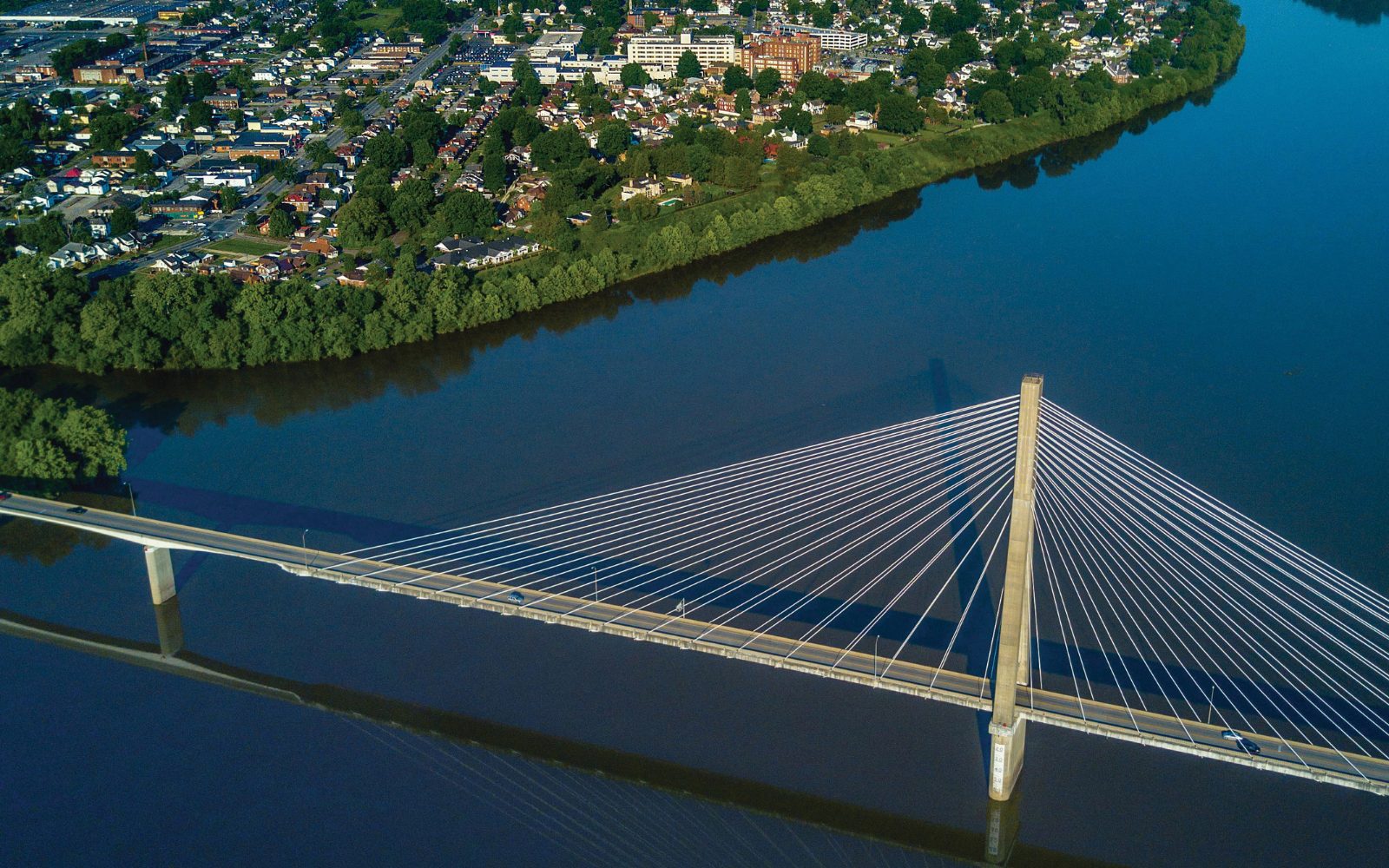
A city rich in history and natural beauty is charting a bright future by working more closely with Marshall University.
When rail tycoon Collis P. Huntington first stood on the banks of the Ohio River and looked south to the nearby rugged hills, he envisioned a busy city that could take shape there, between the ri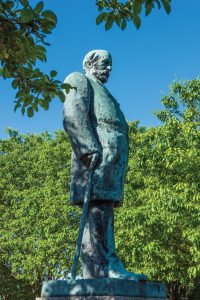 ver and the hills. After founding the City of Huntington in 1871, he began working to lure the kind of rugged, resourceful individuals he knew would be needed to build and sustain a thriving metropolis. And so it happened.
Those first arrivals to Huntington’s new city established steel mills, iron works and glass plants. They opened an array of retail and wholesale businesses, serving the many needs of the growing community and surrounding coalfields. They constructed homes and schools, churches and hospitals, linked by broad, tree-lined streets. Rich in natural beauty, it soon became known as the Jewel City.
But in recent years, Huntington, like so many other cities, has been beset by thorny problems. A city that once had a powerful industrial base has seen it wither.  The city’s population has steadily declined. But make no mistake about it — today Huntington is attacking those problems with a vigor not seen in the past.
“Over the past several years, Huntington has seen meaningful investment in its downtown, riverfront and neighborhoods, alongside a growing sense that the city’s best chapters are still ahead,” said Marshall University President Brad D. Smith. “The next phase of our future is about becoming a place where talent chooses to stay, return or put down roots; where innovation and quality of life reinforce one another; and where economic growth is durable and distinctly Appalachian in character.”
Smith explained that cities that win in this era are those that align education, workforce, health and entrepreneurship around a common vision.
“Marshall University sits at the center of that alignment,” said Smith. “Through our ‘Marshall For All, Marshall Forever’ strategy, we are investing in individual success, innovative ideas and regional economic impact, because a great university and a great city rise together.”
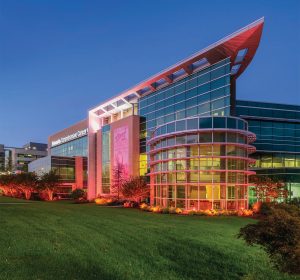
A key component of these efforts is the development of the Marshall IDEA District, a $200 million-plus initiative located along Fourth Avenue that is designed to bring together students, faculty, entrepreneurs, employers and community partners to focus on applied research, startups, advanced manufacturing, cybersecurity and health care innovation.
 The evidence demonstrates our shared efforts are working,” he said. “We’ve expanded research and applied innovation and launched initiatives in cybersecurity, advanced manufacturing, health care and entrepreneurship. When Marshall grows stronger, Huntington grows stronger.”
Patrick Farrell, Huntington’s new mayor, said his vision for the city he grew up in is to make it a catalyst for growth and prosperity by focusing on public safety, building up the city’s neighborhoods and improving infrastructure, preventing flooding and reenergizing the city’s economy.
Farrell said the city is working closely with Marshall as it transforms Fourth Avenue from Hal Greer Boulevard to downtown, anchored by the Brad D. Smith Center for Business and Innovation and the Institute for Cybersecurity.
“Working with Marshall, we will create a safer, stronger and more vibrant city,” Farrell said. “Huntington will be a city we are proud to call home and a place the next generation will love as much as we do.”
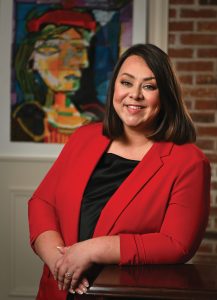 Looking ahead, Megan Archer, president and CEO of the Huntington Regional Chamber of Commerce, said she sees Huntington’s future as one of “momentum, opportunity and shared purpose.”
“I envision a community where businesses of all sizes thrive, talent chooses to stay and grow here and innovation is fueled by collaboration across industries and institutions,” Archer said. “It’s a future where economic growth goes hand in hand with quality of life — where our downtown is vibrant, our workforce is prepared for the jobs of tomorrow and our region is recognized not just for where we’ve been, but for where we’re going.”
Huntington Highlights
RITTER PARK
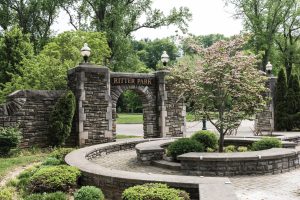 Huntington has an extensive network of public parks, with 75-acre Ritter Park long considered its crown jewel. Ritter is known for its walking path — a crushed limestone loop popular with walkers, joggers, dog walkers and bicyclists. Other Ritter favorites are its award-winning Rose Garden, the adjacent Room with a View and its popular dog park.
PULLMAN SQUARE
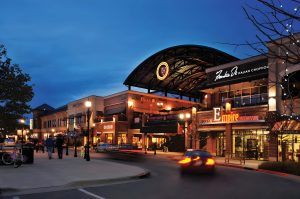 Opened in 2004, Pullman Square breathed new life into downtown Huntington when it replaced the Superblock, a large tract of land that had been vacant since the 1970s. Located between Eighth and 10th streets and between Third Avenue and the Ohio River, Pullman has retail shops, restaurants and a movie theater.
THE KEITH-ALBEE
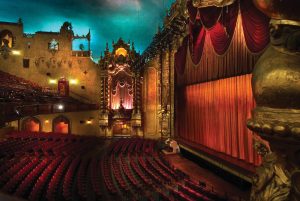 The curtain is up again at the grand Keith-Albee Performing Arts Center following a two-year, $30 million facelift that restored its grandeur. Opened in 1928 as a vaudeville palace, the Keith was Huntington’s premier theater for decades. After declining movie audiences led to its closure, the building was donated to Marshall University, then transferred to a private foundation that embarked on the demanding task of bringing it back to life — a feat now wonderfully accomplished.
MARSHALL SPORTS
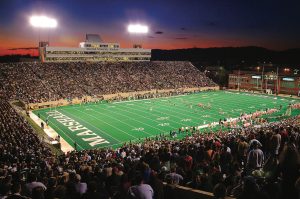 Loyal Marshall University sports fans have plenty to cheer about. It’s not just football and basketball. It’s more. Much more. It’s baseball, soccer, swimming and diving, golf, tennis, volleyball, cross country and track and field. “We Are…Marshall!”
CAMDEN PARK
 Just west of Huntington on U.S. 60 is a landmark that’s been attracting fun-seekers for more than a century. Built in 1903, Camden Park was one of hundreds of amusement parks built by streetcar lines as a way of bolstering their ridership. Most are gone now, but Camden Park is one of a handful that survived. Roller coaster fans from all over the country come to the park to ride its wooden coaster, the Big Dipper.
James E. Casto is a freelance writer living in Huntington, West Virginia.