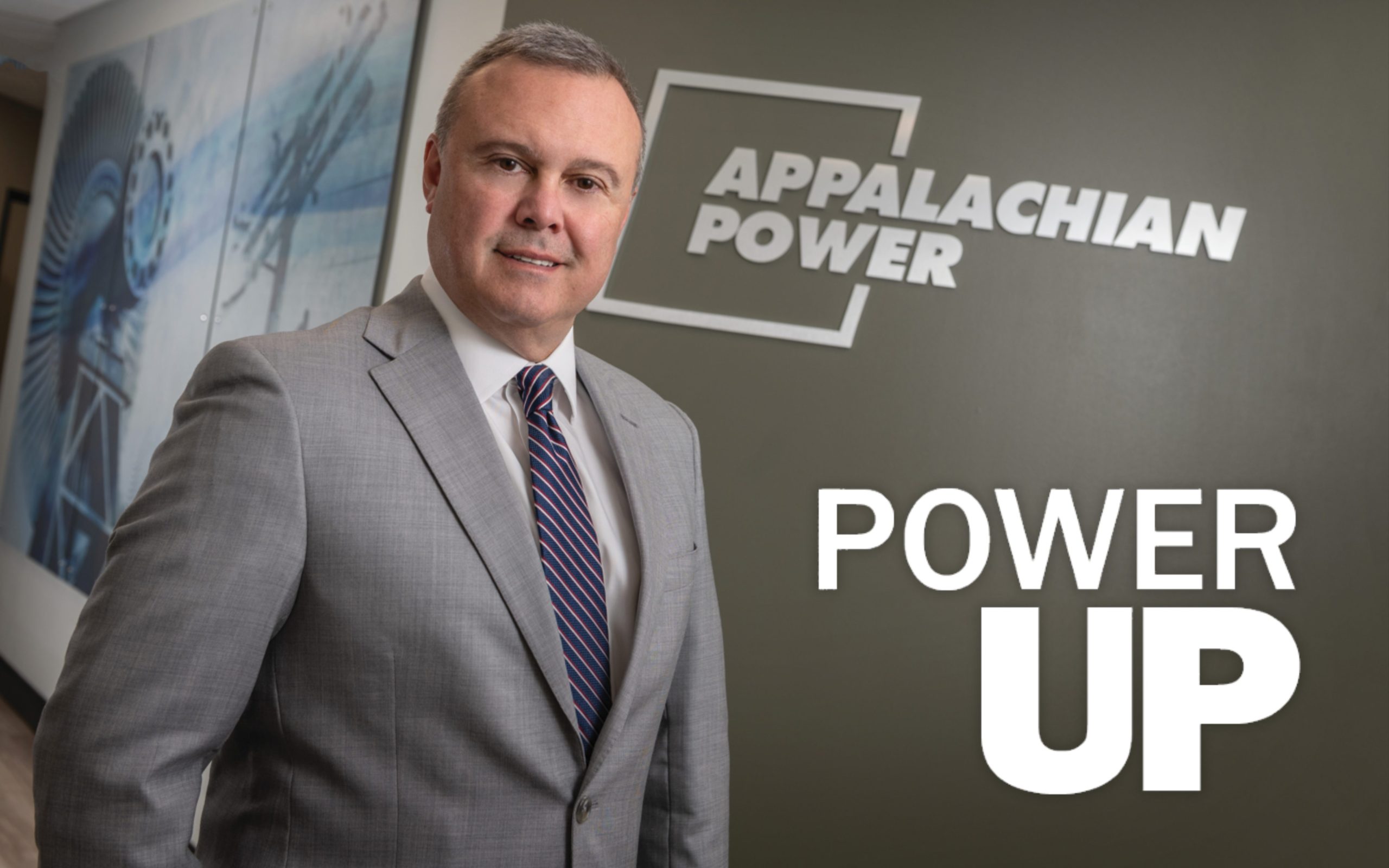
When Brian Abraham was named president and chief operating officer for Appalachian Power Company (APCo) in April of this year, he stepped into a role that positions the company to tackle some unique challenges facing the 100-year-old electricity provider in its West Virginia territory, including improving communication with customers who rely on APCo for their electricity needs, building back supplier relationships and partnering with legislators and community leaders to pursue economic development opportunities, to name a few.
In the early weeks following the announcement, Abraham quickly embraced his new role and traveled to various locations to meet directly with managers and others, holding listening sessions to share ideas and hear directly from the people at APCo doing the work within their respective communities. It is this type of information-gathering that will help guide his long-term strategy.
“I’ve been a customer of Appalachian Power for some 30 years now,” Abraham said. “I understand that we need to work together as a team to do things better. We’re going to execute things on a grand scale.”
Abraham’s West Virginia roots are indeed firmly planted. Born and raised in the coalfields of Logan County, his humble beginnings include riding in the back of his grandparents’ pickup truck for them to pay their “light bill” on time, and always in person. As the young son of a coal miner during times when electricity in their rural town was limited and unstable, Abraham’s early experiences have long since propelled him to an impressive career that not only cuts across public service and the legal field, but also has afforded him unique opportunities to collaborate with lawmakers and the business sector to achieve positive outcomes for communities across the state.
That same blend of personal experience, public service and practical problem-solving has shaped a career path that defies the traditional profile of a utility executive. Most recently, Abraham served as chief of staff to Sen. Jim Justice, a position he also held during Justice’s second term as governor, as well as being general counsel for the Justice Administration. Before that, he served as a prosecuting attorney for Logan County and was a special assistant U.S. attorney for the states of Kentucky and Tennessee. And then there’s his military career with the U.S. Army: in 2025, Abraham retired as brigadier general with the West Virginia National Guard after 22 years of service.
Abraham said these combined experiences will serve him well at APCo.
“The skills and training I gained from the military and through public service easily translate into the business world for me,” he said. “In each situation, you have to rely on people to get their job done, and that also means providing them with the resources they need to do it.”
A Customer-Centric Approach
Abraham is working to identify new ways APCo can communicate more clearly with customers, helping them better understand changes in service delivery and rates. This approach includes evaluating the company’s current systems, processes and tools to make informed decisions and recommendations for ways to improve delivery. Progress often happens incrementally. For example, customers are currently able to track service interruptions and estimated times for restoring power in their area by using an interactive map. They can also access a mobile app to report power outages, check the status of an outage and manage their account. Customers can also stay informed through text and email alerts.
APCo currently uses the Modified Rate Base Cost (MRBC) tracker to recover upgrade costs between full-base rate case reviews, helping make rate adjustments more gradual and predictable.
“We have to do a better job with transparency and messaging to the community, taking into consideration that we also have an aging population in the state and socioeconomic factors that require us to continue to seek innovative and effective ways to engage them,” Abraham noted.
Beyond the Surface
West Virginia’s natural beauty lends itself to the ever-popular “Almost Heaven” slogan, but its topography presents some unique challenges to economic growth. With steep slopes, rural hollows and increasing vulnerability to storms, ice and flooding, electricity outages can become more common and infrastructure improvements are made more costly. These geographic realities are closely tied to the state’s ability to attract and support new business investment, Abraham said, while also affecting the success of existing businesses and the retention of the skilled workforce that supports them.
“When a business closes, it causes other businesses to shoulder a bigger burden,” he explained.
The Power Shift
Also important in APCo’s long-term strategy is integrating more renewable energy sources to diversify beyond coal and achieve carbon reduction targets. This includes exploring Small Modular Reactors to support growing energy demand and increasing purchase agreements.
“It’s really important for us to build back our supplier relationships in West Virginia,” Abraham said. “They support reliable service, cost management, regulatory compliance and operational resilience.”
While APCo’s focus remains on centralized improvements with increased distributed elements, it’s these types of efforts that benefit customers by reducing extended power outages and providing better tools to manage their bills.
“Economic revitalization is essential to full modernization and shared responsibility throughout the residential community and business sector,” Abraham said.
Population Pressures
Another important consideration for APCo — one that may not get as much public attention as electricity rates — is the impact of a declining population on energy solutions and affordability. Over the past decade, West Virginia experienced a population decline of nearly 4.3%, equating to a loss of between 77,000 and 80,000 residents. While there are efforts to attract more young people and remote workers to the state, this downward trajectory is concerning, particularly with such a large demographic of older residents.
“It has a tremendous impact on the load of power usage,” Abraham said. “We need to stabilize this situation to ease the burden on our residents.”
In essence, a shrinking customer base spreads fixed costs across fewer customers and contributes to rate pressures.
An Electrifying Future
Abraham said his work with policymakers and the business sector has given him reason to be optimistic about West Virginia’s economic future, particularly as new manufacturing opportunities continue to emerge.
“I believe we’re on a renewed path,” he said, noting examples like exploring innovative tax incentives and reclaiming surface mine areas, particularly in southern West Virginia, where opportunity exists for bottom-line progress that is essential to maintaining stability as an electricity provider. “We need to make it easier for businesses to come here and be a partner, not an impediment, in negotiating rates.”
The same hometown values instilled within him while growing up in Logan also extend to the people doing the work to ensure reliable electric service for their family and neighbors.
“There’s a strong sense of community in West Virginia,” Abraham said. “This is about looking out for each other, and that’s what I’m focused on the most.”
Shelly Ridgeway is a freelance writer living in Huntington.